Progressive overload means gradually increasing the challenge your body must handle. At home, that can happen with heavier weight, but it can also come from more repetitions, better range of motion, harder variations, additional sets or improved control. The goal is not to make every session brutal. It is to create a measurable reason for adaptation while preserving good technique and recovery.
A personalized plan should match your current ability, available equipment and real weekly schedule. The goal is not temporary exhaustion; it is a process you can understand, measure and continue.
Start with a repeatable baseline
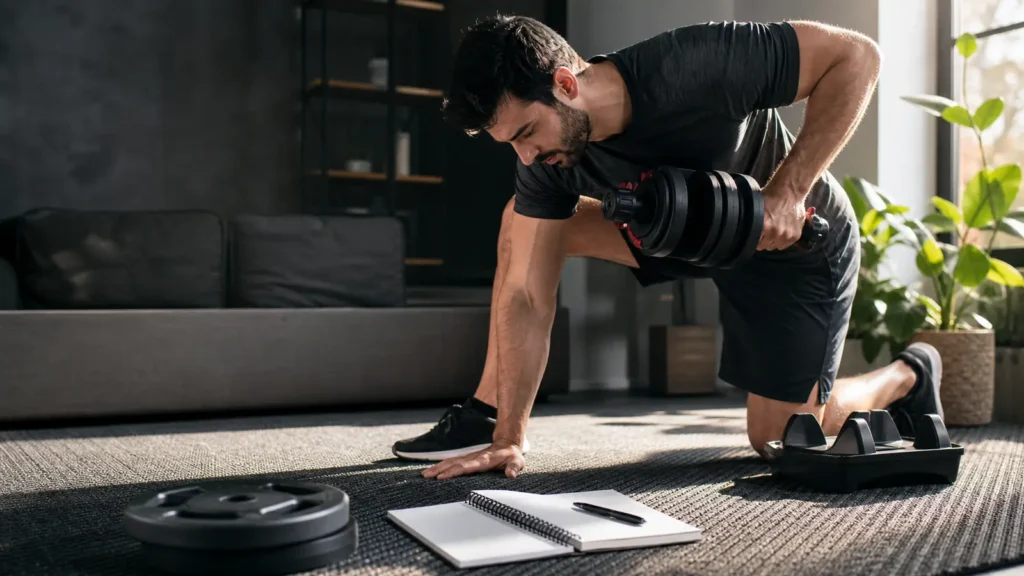
Choose exercises you can perform consistently and record the load, repetitions, sets and effort. If the movement changes every session, comparison becomes difficult. A baseline should be challenging enough to matter but leave room to improve.
Use double progression
Select a repetition range, such as 8–12. Keep the same load until you can reach the top of the range across the planned sets with solid form and the intended effort. Then increase resistance slightly and begin again near the lower end. This creates a clear rule for adjustable dumbbells and bands.
Progress without heavier weights
Add repetitions, slow the lowering phase, pause in the hardest position, increase range of motion or choose a more demanding unilateral version. You can also add a set, but more volume increases recovery needs. Change one main variable at a time so you know what caused the new challenge.
Not every workout must improve
Performance varies with sleep, stress, nutrition and schedule. Judge progress across several weeks, not one day. Holding performance during a stressful period may be a success. Planned easier weeks can reduce fatigue and prepare you to progress again.
Signs you progressed too quickly
Technique that changes dramatically, joint pain, persistent fatigue or repeated performance decline can signal that the increase was too aggressive. Reduce the load or volume and rebuild. Muscle effort is expected; sharp or worsening pain is not a target and deserves appropriate assessment.
What a realistic week can look like
A practical week does not need to copy an athlete’s schedule. It might include two or three full-body strength sessions, moderate walking or other enjoyable aerobic activity, and at least one lower-demand day. Place the hardest work where sleep and time are normally best. If a session must move, preserve the overall pattern instead of squeezing hard days together. The exact dose depends on experience and recovery, but a stable structure makes it easier to see whether progressive overload at home is actually producing results.
Before adding more work, ask whether the current plan is being completed with good technique. More exercises only help when they can be recovered from. Small progress repeated for several months is more valuable than a dramatic first week followed by fatigue or abandonment.
A simple way to put this into practice
- Choose one clear outcome for the next eight to twelve weeks.
- Set a realistic weekly training frequency and a shorter backup session.
- Record exercises, loads, repetitions and effort.
- Review trends every two to four weeks instead of reacting to one day.
- Adjust the plan when schedule, recovery or performance changes.
Frequently asked questions
Do I need to be fit before I start?
No. The starting version should match your present capacity. Difficulty can come from movement choice, range, resistance, repetitions and rest, so almost every plan can be scaled.
How often should the plan change?
Not on a fixed weekly schedule. Keep useful exercises long enough to learn and measure them, then adjust when progress, comfort, equipment or goals require it. A review every few weeks is more informative than random daily changes.
When should I stop and seek help?
Stop for sharp pain, faintness, chest pain or unusual symptoms and seek appropriate medical guidance. Training advice does not replace diagnosis or treatment. When the issue is program design rather than health, a qualified coach can modify the exercise, range or workload.
Evidence note: Recommendations are educational and intended for generally healthy adults. See the Physical Activity Guidelines for Americans. Nutrition or medical conditions require individualized care.
Build your plan with Kairon Training
Kairon Training creates individualized online programs for adults across the United States. We combine structured strength training, technique guidance, progress tracking and direct support so the plan fits your life and keeps evolving with your results. Explore our online personal training or contact us to discuss your goal.
Work with an online personal trainer in the USA
See our online personal training plans or contact us to tell us your goal.