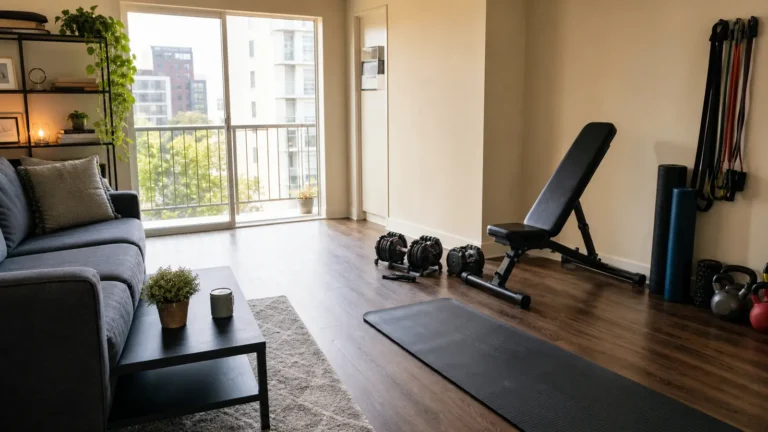
Yes, you can build muscle at home with dumbbells. Your muscles respond to tension, effort, sufficient training volume, and recovery—not to the address where you exercise. A commercial gym makes it easy to add load, but adjustable dumbbells, a bench or chair, and thoughtful programming can support substantial progress.
The real limitation is rarely the absence of machines. It is failing to make exercises challenging enough as you get stronger.
What causes muscle growth?
Resistance training asks muscle fibers to produce force. When that work is repeated, progressed, and supported by recovery, the body adapts. Research comparing different loading ranges indicates that muscle growth can occur with lighter or heavier loads when sets are sufficiently demanding, although heavier training tends to produce greater improvements in maximal strength.
This is useful at home: you do not always need the heaviest possible dumbbell. You do need sets that become hard near the end and a way to increase the challenge over time. See the systematic review on low- and high-load resistance training.
The best dumbbell movements for a home program
A balanced plan should cover the main movement patterns rather than collect dozens of isolated exercises:
- Knee-dominant: goblet squat, split squat, reverse lunge, or step-up.
- Hip-dominant: Romanian deadlift, single-leg deadlift, or weighted glute bridge.
- Horizontal press: dumbbell floor press or bench press.
- Vertical press: standing or seated overhead press.
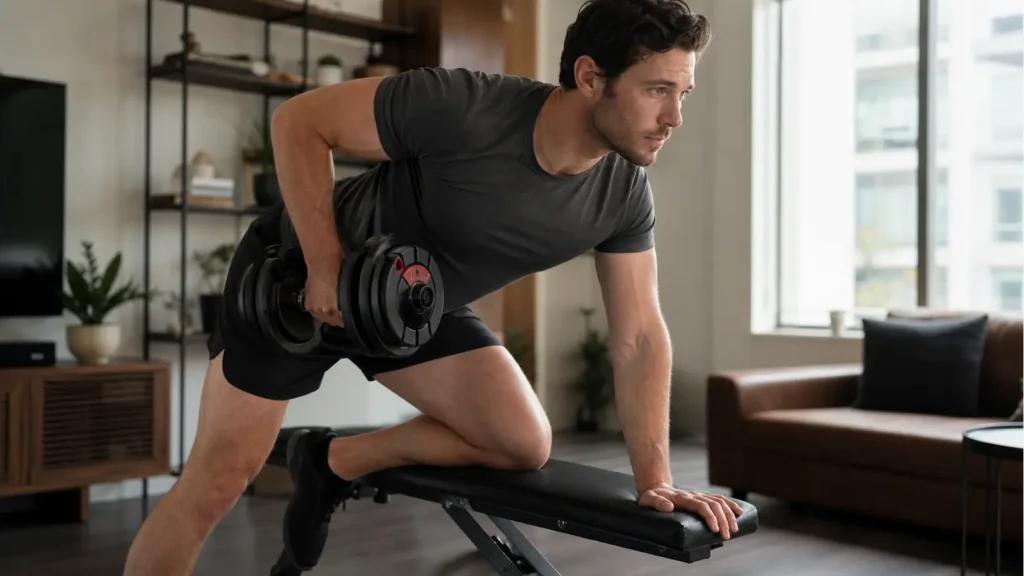
- Pull: one-arm row, chest-supported row, or dumbbell pullover where appropriate.
- Additional work: lateral raises, curls, triceps extensions, calf raises, and loaded carries.
Not every session needs every movement. Across the week, train the muscle groups you want to develop with enough repeated exposure to improve your technique and performance.
A three-day dumbbell example
For a healthy adult with some basic experience, three full-body sessions can be efficient. On day one, use goblet squats, floor presses, one-arm rows, Romanian deadlifts, and lateral raises. On day two, choose split squats, overhead presses, pullovers or rows, glute bridges, curls, and triceps extensions. On day three, repeat the patterns with the variations you can progress most reliably.
Begin with two or three working sets per exercise and mostly 6–15 repetitions. Higher repetition sets can work when dumbbells are light, but they should still be controlled and challenging. Leave one to three repetitions in reserve on most sets instead of forcing failure on every exercise.
How to use progressive overload with limited weights
Add weight when possible, but do not treat load as the only tool. You can add repetitions, add a set, improve range of motion, slow the lowering phase, pause in a difficult position, or move from a bilateral exercise to a unilateral variation. A Bulgarian split squat makes one moderate dumbbell far more demanding than a two-legged squat.
Use these methods selectively. Combining more sets, more repetitions, slower tempo, and shorter rest at once makes it impossible to know what produced the change and may create unnecessary fatigue.
How often should you train each muscle?
Two or three full-body days work well for many home trainees because each muscle receives multiple weekly opportunities without requiring daily workouts. More advanced lifters may prefer an upper/lower split. Total effective work and recovery matter more than the name of the split.
If you are unsure how many days fit your schedule, read how many days per week you should train. Start with the minimum schedule you can follow consistently and add work only when performance and recovery support it.
Nutrition and recovery
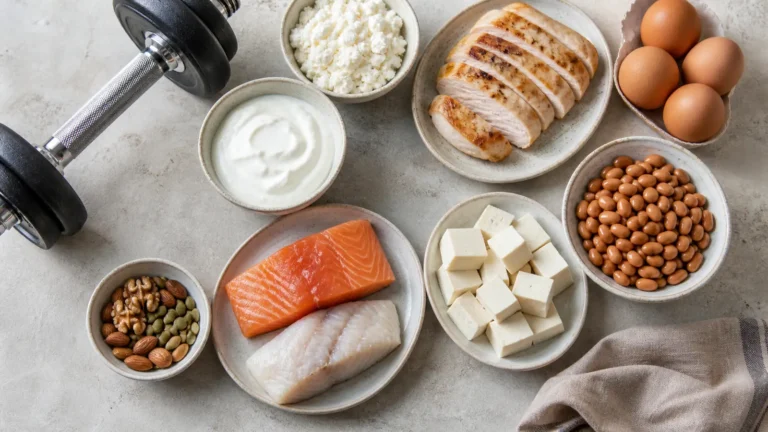
Building muscle requires adequate energy and protein, but exact needs vary with body size, total diet, training status, and goals. Spread protein-containing foods across regular meals, include fruits, vegetables, carbohydrates, and healthy fats, and avoid expecting a supplement to replace consistent nutrition.
Sleep and stress affect training quality. If performance declines across several sessions, joints become increasingly uncomfortable, or motivation collapses, review volume and recovery rather than automatically adding more exercise.
When dumbbells may no longer be enough
If you can perform very high repetitions with excellent control and cannot make a movement harder safely, you may need heavier adjustable dumbbells, bands, a weighted vest, or gym access. This often happens first with lower-body exercises. It does not mean the home phase failed; it means your capacity improved.
Build your home program around the equipment you own
Kairon Training designs online programs around your actual dumbbells, space, schedule, and goal. We select progressions, monitor performance, and adjust the plan so limited equipment does not become random training.
Contact Kairon Training or see our online coaching options across the USA. We can turn your home setup into a structured muscle-building process.
This article is educational and not a substitute for medical or individualized clinical advice.
Work with an online personal trainer in the USA
See our online personal training plans or contact us to tell us your goal.