
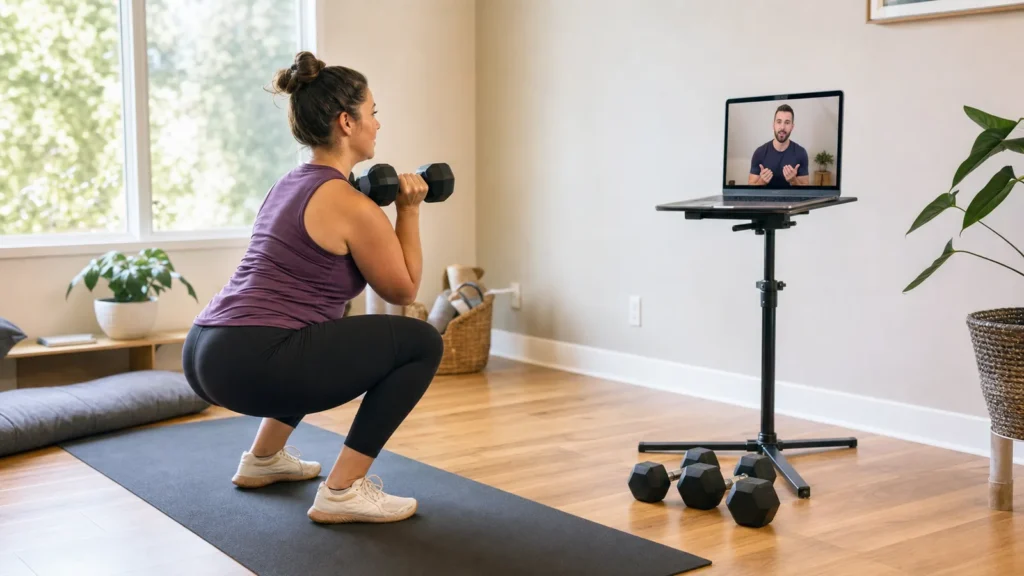
Is online personal training worth it? It can be when you need more than a list of exercises. A good online coach builds a plan around your goals, experience, schedule and available equipment, then reviews your progress and adjusts the program over time. It is less useful when you only want a generic routine or when your situation requires hands-on medical or rehabilitation support.
The real question is not whether online coaching works for everyone. It is whether the service gives you the specific guidance, accountability and flexibility you need to make consistent progress.
What does online personal training actually include?
Online personal training is not simply a PDF workout sent by email. In a well-designed service, the coach begins by learning about your training history, goals, availability, preferences and limitations. That information becomes the basis for an individualized program.
Depending on the service, coaching may include:
- An initial assessment and goal-setting process.
- A personalized strength and conditioning plan.
- Exercise demonstrations and technique guidance.
- Weekly check-ins and progress reviews.
- Adjustments to volume, intensity, frequency or exercise selection.
- General nutrition and habit guidance within the coach’s scope.
- Direct communication for questions and feedback.
- Live one-to-one video sessions when more supervision is needed.
The important distinction is ongoing decision-making. A workout app can display exercises, but personalized coaching should explain what to do, why it fits your situation and what needs to change when your progress, schedule or recovery changes.
When is an online personal trainer worth it?
You keep starting but struggle to stay consistent
Knowing that exercise is beneficial does not automatically make it easy to follow a plan. The CDC recommends that adults combine aerobic activity with muscle-strengthening work, but the best weekly structure still depends on the individual.
Regular check-ins create a clear point of accountability. Instead of disappearing from a generic program after a difficult week, you can review what happened and adapt the plan. Research on web-based exercise delivery has found improvements in adherence and confidence in some settings, although results depend on the population and the type of support provided.
You want a plan that fits your real schedule
Many routines assume unlimited time, full gym access and a predictable week. Real life rarely works that way. An online coach can organize two, three, four or more weekly sessions according to your goal and availability, then create alternatives for travel, busy periods or limited equipment.
That flexibility is especially valuable for people who travel, work irregular hours or prefer to train at home. You are not tied to one gym location or a fixed appointment for every workout.
You train regularly but have stopped progressing
Plateaus are not always solved by working harder. Your program may need a change in training volume, intensity, exercise selection, recovery or progression. A coach can examine your training log and decide what to modify instead of replacing the entire routine without a reason.
Personalization also helps prevent the opposite problem: changing exercises so often that you never give the program enough time to work.
You need feedback rather than more information
There is no shortage of free workouts online. The difficult part is identifying which advice applies to you. A coach can review exercise videos, answer questions and help you distinguish a temporary bad session from a pattern that requires an adjustment.
For people who need real-time instruction, live video sessions can provide closer supervision than an asynchronous plan alone. However, online feedback cannot replace in-person medical assessment or physical therapy.
Online personal trainer vs. workout app
A workout app may be enough if you already understand programming, can evaluate your own technique and remain consistent without outside support. Apps are often inexpensive and convenient, and some offer useful exercise libraries and tracking tools.
Online personal training becomes more valuable when the program needs human interpretation.
| Workout app | Online personal trainer |
|---|---|
| Usually follows preset rules | Builds decisions around your context |
| Tracks completed workouts | Reviews what the data means |
| May change workouts automatically | Adjusts the plan for a stated reason |
| Limited individual feedback | Provides direct questions and feedback |
| You manage accountability alone | Check-ins create shared accountability |
The technology is not the deciding factor. Both services may use an app. The difference is whether a qualified person is actively evaluating your response and making individualized decisions.
What are the limitations?
Online coaching is not automatically the best option in every situation. You may benefit from in-person support if you are learning complex movements and cannot record them clearly, if you strongly prefer face-to-face interaction or if you need physical assistance during training.
People with pain, significant injuries, pregnancy-related concerns, chronic conditions or symptoms triggered by exercise should obtain appropriate medical guidance before beginning or changing a program. Personal training does not diagnose or treat medical conditions.
Quality also varies. The title “personal trainer” alone does not prove that someone is qualified. The American College of Sports Medicine recommends asking about education, certification and relevant experience. You should also understand how communication works, how often the program is reviewed and what support is included.
How to decide if it is worth the investment
Before hiring an online personal trainer, ask these questions:
- Is the plan created from an individual assessment?
- How often will the coach review my progress?
- What happens if my schedule, equipment or recovery changes?
- Can I send exercise videos and receive useful feedback?
- Is nutrition guidance appropriate and within the coach’s scope?
- Are the coach’s qualifications and experience relevant to my goals?
- Is the service available in my preferred language and time zone?
- What level of communication is included?
The service is more likely to be worth it when the answers are specific. “Access to an app” is not the same as personalized coaching. Look for a process that includes assessment, planning, review and adjustment.
The bottom line
Online personal training is worth considering if you want a structured plan, professional feedback and regular adjustments without being limited to one location. Its greatest value is not the number of workouts you receive. It is having someone interpret your progress and help you make better decisions over time.
At Kairon Training, we build online training around your goals, experience, schedule and available equipment. Our service combines individualized programming, weekly follow-up, ongoing adjustments and nutrition guidance, with options for live one-to-one video sessions. If you want to stop guessing and train with a clear direction, explore our online personal training plans or contact Kairon Training to discuss the support that fits you best.
Sources
- CDC: Adult Activity—An Overview, accessed August 4, 2026.
- PubMed: Web-Based Exercise Programming and Home Exercise Adherence, accessed August 4, 2026.
- ACSM: Investing in a Personal Trainer, accessed August 4, 2026.